
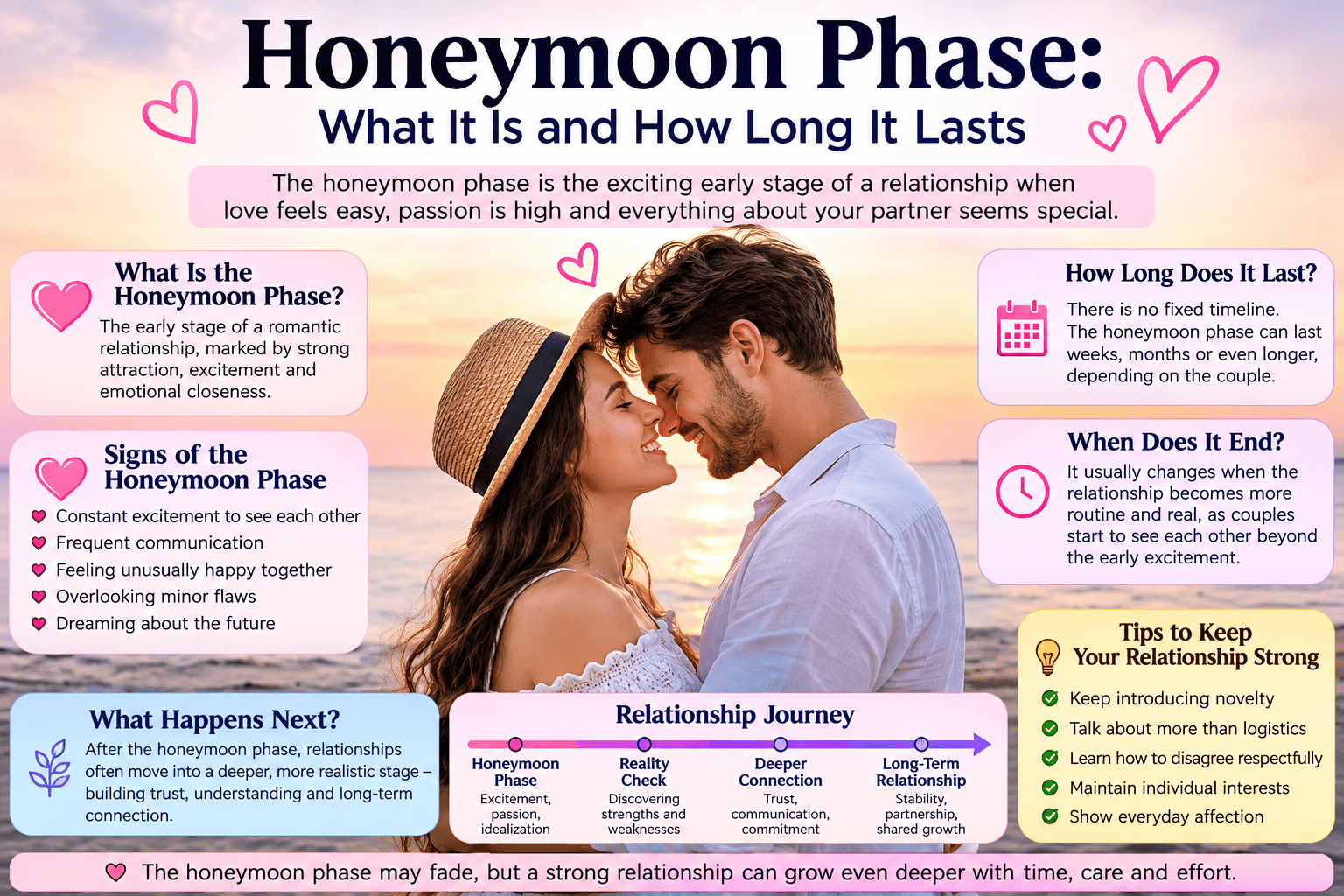
The honeymoon phase is often described as the exciting beginning of a romantic relationship, when spending time together feels effortless, attraction is strong, and even small things about your partner seem special. For many couples, this period can feel almost unreal.
But what is the honeymoon phase really, and how long does the honeymoon phase last?
There is no universal timeline. Some couples experience intense excitement for a few months, while others feel it for a year or longer. Some do not experience a dramatic honeymoon period at all. More importantly, the end of intense early excitement does not automatically mean a relationship is failing.
Understanding this transition can help couples distinguish between a normal change in relationship dynamics and genuine problems that deserve attention.
What Is the Honeymoon Phase?
The honeymoon phase is the early stage of a romantic relationship characterized by strong attraction, excitement, affection, and a tendency to focus on a partner's positive qualities.
During this period, couples may:
- Want to spend most of their free time together
- Communicate frequently throughout the day
- Feel unusually excited about seeing each other
- Overlook minor habits or differences
- Experience strong physical and emotional attraction
- Talk enthusiastically about their future together
The honeymoon period meaning is therefore less about a specific number of months and more about a particular emotional experience.
It is also important to remember that the honeymoon phase is not a scientific diagnosis or a fixed relationship stage. People experience relationships differently depending on personality, circumstances, previous experiences, and how quickly the relationship develops.
A simple example
Imagine two people who have been dating for three months. They constantly text each other, plan weekend activities, and feel excited whenever they meet.
Six months later, they still care deeply about each other, but their communication has become more routine. They have discovered each other's annoying habits, discussed finances, and experienced their first serious disagreement.
That does not necessarily mean their relationship has become worse. It may simply mean they are moving from early infatuation toward a more realistic and established connection.
How Long Does the Honeymoon Phase Last?
So, how long does the honeymoon phase last?
There is no scientifically established expiration date. It can last several weeks, several months, or considerably longer depending on the couple.
Research does show that relationship satisfaction can change over time. A large systematic review and meta-analysis examined 165 independent samples involving more than 165,000 participants and found that relationship satisfaction tended to decline during the early years of relationships, although individual experiences varied considerably.
This is an important distinction. A statistical trend across many relationships cannot predict exactly what will happen in one person's relationship.
You might notice the honeymoon stage changing after six months, while another couple may experience a similar transition after two years.
When Does the Honeymoon Phase End?
There is no single answer to when does the honeymoon phase end.
Instead of looking for a specific date, pay attention to changes in the relationship.
The early excitement may gradually become less intense when:
- Daily routines replace constant novelty
- You become more comfortable expressing disagreement
- You see your partner's weaknesses more clearly
- Work, finances, family, or other responsibilities become part of the relationship
- Communication becomes less frequent but potentially more meaningful
- Physical attraction remains, but the constant excitement decreases
The key point is that the relationship is becoming more realistic.
During the early stage, you may know your partner primarily through dates, conversations, and exciting experiences. Over time, you learn how they behave when they are stressed, disappointed, tired, or dealing with an ordinary Monday.
That information can actually create a stronger foundation for long-term compatibility.
Signs You May Be Moving Beyond the Honeymoon Stage
Moving beyond the honeymoon stage of a relationship is not necessarily negative.
Some common signs include:
You are more comfortable being yourself
You no longer feel pressure to appear perfect around your partner. You can have an awkward day, disagree about something, or admit that you need personal space.
Conflicts become more visible
Arguments that were rare during the early months may become more noticeable. Healthy relationships are not conflict-free. What matters is whether disagreements can be handled respectfully.
The relationship feels more predictable
You may stop planning elaborate dates every week and become comfortable doing ordinary things together, such as cooking dinner or watching a movie.
Your feelings become calmer
The constant butterflies may decrease while affection, trust, and emotional security increase.
This distinction matters. Passion and emotional security are not identical experiences.
Does the End of the Honeymoon Phase Mean You Are Falling Out of Love?
Not necessarily.
One common mistake is comparing today's relationship with its most exciting early period. If the comparison is based only on intensity, almost any established relationship can appear disappointing.
Research also suggests that people's beliefs about passion matter. A study published in the Journal of Personality and Social Psychology found that people who strongly believed romantic passion inevitably declines were more likely to show lower commitment and greater interest in alternatives when passion was low.
In other words, believing that reduced excitement automatically means love is disappearing can influence how you interpret normal changes.
Instead of asking, "Why don't I feel exactly the same as I did six months ago?" consider asking:
- Do I still respect my partner?
- Can we communicate honestly?
- Do I feel emotionally safe?
- Can we solve problems together?
- Do we enjoy spending ordinary time together?
- Are our important values compatible?
These questions provide a much better picture of relationship health.
How to Keep a Relationship Strong After the Honeymoon Phase
You cannot realistically preserve the exact emotional intensity of a new relationship forever. You can, however, continue creating connection.
1. Keep introducing novelty
Try a new restaurant, learn something together, take a different route on a weekend walk, or plan an activity neither of you has tried before.
Research has found that romantic passion can decline with relationship duration, but the decline is not inevitable or identical for everyone.
2. Talk about more than logistics
Conversations about bills, schedules, and chores are necessary, but they should not become the entire relationship.
Ask about your partner's goals, worries, interests, memories, and plans.
3. Learn how to disagree
Healthy communication does not mean avoiding every argument. It means being able to disagree without insults, threats, manipulation, or deliberately hurting each other.
4. Maintain individual lives
A strong relationship does not require two people to do everything together. Friendships, hobbies, personal goals, and alone time can help both partners maintain a sense of identity.
5. Notice everyday affection
Long-term connection is often built through small actions rather than dramatic romantic gestures. A thoughtful message, a hug after a difficult day, or helping with an unpleasant task can communicate care.
When a Change in Feelings Deserves Attention
A decrease in butterflies is normal. A persistent pattern of disrespect, dishonesty, fear, manipulation, or emotional disconnection is different.
Pay attention if you consistently feel:
- Unsafe expressing your opinions
- Disrespected or controlled
- Unable to resolve recurring problems
- Completely disconnected from your partner
- Pressured to stay despite serious concerns
The goal is not to recreate the first few months of a relationship at any cost. It is to understand whether the relationship is developing into something healthy and sustainable.
Conclusion
The honeymoon phase can be an exciting part of falling in love, but it is not the only measure of a successful relationship. There is no universal answer to how long it lasts, and when the honeymoon phase ends varies from couple to couple.
As the initial excitement changes, partners have an opportunity to build something more realistic: trust, communication, emotional security, shared experiences, and genuine understanding.
If you want to explore more relationship and dating psychology topics, Favor can be one useful place to continue learning, but the most important work still happens between two people.
FAQs
How long does the honeymoon phase last?
There is no fixed duration. It may last weeks, months, or longer depending on the couple and circumstances. Research shows relationship satisfaction changes differently across individuals and relationships.
What is the honeymoon phase in a relationship?
The honeymoon phase is the early period when romantic attraction, excitement, affection, and idealization of a partner may feel especially strong.
When does the honeymoon phase end?
There is no specific ending point. It often changes gradually as couples become more familiar with each other and everyday responsibilities become part of the relationship.
Is it normal to lose feelings after the honeymoon phase?
A decrease in excitement does not automatically mean you are losing love. Passion can change as emotional familiarity and security develop. However, persistent unhappiness or serious relationship problems should not be ignored.
Can you bring back the honeymoon feeling?
You may not be able to recreate the exact experience of a new relationship, but novelty, affection, meaningful conversations, shared activities, and intentional time together can help maintain connection and passion.